Tenstorrent and AutoCore Announce Strategic Partnership
Tenstorrent and AutoCore Announce Strategic Partnership to Power High-Performance RISC-V Automotive Computing with AutoCore.OS
Tenstorrent and AutoCore are combining AutoCore’s production-proven automotive software platform with Tenstorrent’s best-in-class TT-Ascalon™ RISC-V cores to offer a scalable, open-standard architecture for global OEMs.
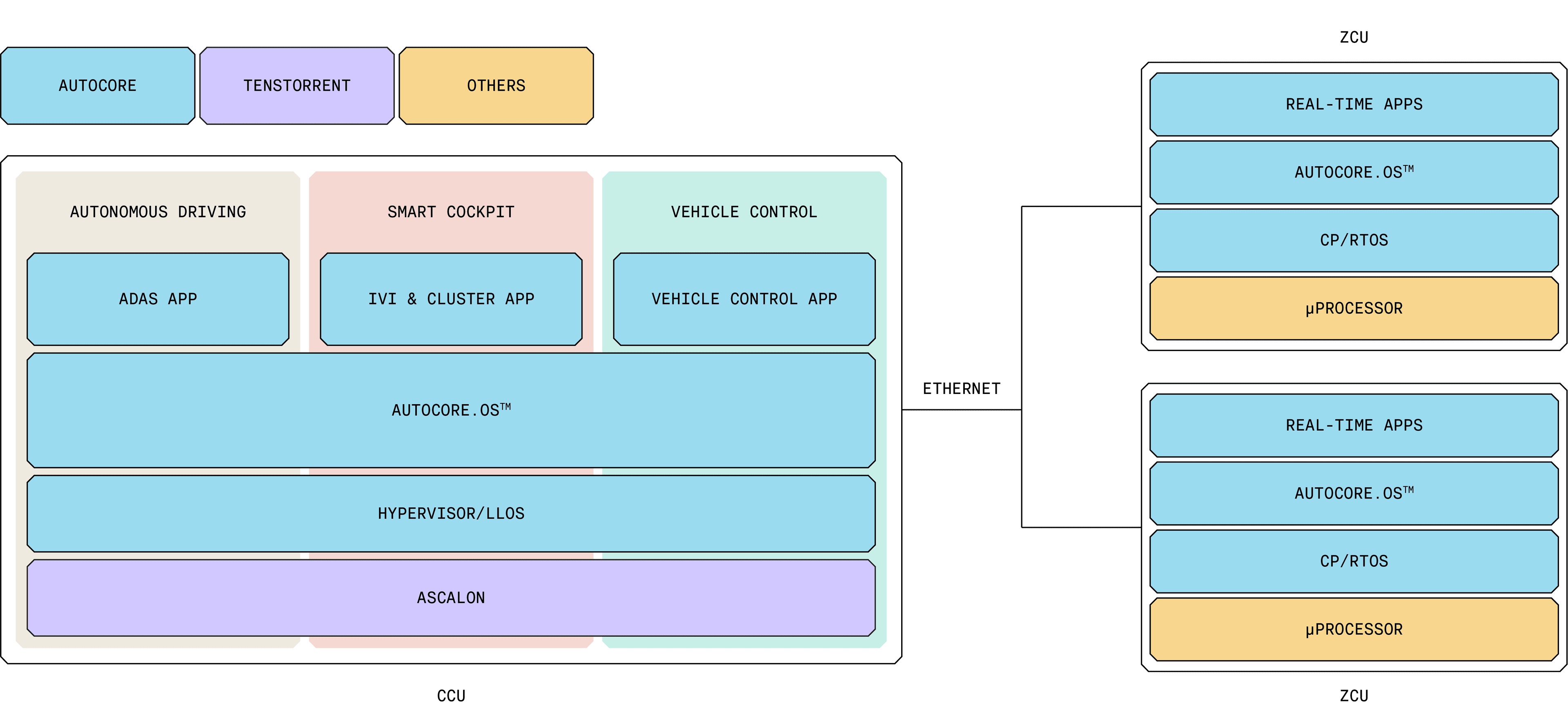
AutoCore.ai, a leading provider of scalable, high-performance and functional safety Software-Defined Vehicle platforms, and Tenstorrent, a leader in high-performance RISC-V CPUs and AI, jointly announced a strategic partnership today. AutoCore will enable Tenstorrent’s high-performance RISC-V processor platform TT-Ascalon™ with its flagship product, AutoCore.OS(™).
As the automotive industry accelerates toward Software-Defined Vehicles (SDV), the demand for high-performance, open, and flexible computing platforms has never been higher. This collaboration marks a significant milestone in the integration of mature automotive software with high-performance RISC-V based CPU and AI platforms.
AutoCore offers a complete, full-stack automotive system software platform that supports diverse Electrical/Electronic (E/E) architectures—from domain controllers to central computing units—and is compatible with a wide range of heterogeneous chip platforms. AutoCore.OS enables the seamless development and deployment of applications across all functional domains, including Autonomous Driving (ADAS), Intelligent Cockpit, and Vehicle Control, providing a unified and robust base for next-generation vehicles.
Powering this software is Tenstorrent’s Ascalon RISC-V based CPU, the highest-performance RISC-V processor in the industry designed for automotive, infrastructure, and AI workloads. Ascalon is an RVA23 compliant, 64-bit core featuring an out-of-order, superscalar architecture and 256-bit vector data paths, delivering the computational density required for complex automotive workloads.
The collaboration leverages AutoCore’s deep industry experience to accelerate the adoption of RISC-V in the automotive sector. As a leading supplier in the automotive industry, AutoCore brings a wealth of mass-production experience. This proven track record provides the critical software maturity needed to deploy RISC-V hardware architectures with confidence. By combining their product with Tenstorrent’s Ascalon, which supports easy migration from existing chip solutions, this partnership significantly reduces the time required to move from prototype to mass production.
The joint solution breaks the monopoly of traditional closed architectures. Tenstorrent’s commitment to open solutions —offering options for ISA extensions and Functional Safety (FUSA) support—paired with AutoCore’s flexible software configuration, provides OEMs with unprecedented freedom to optimize for specific applications.
“As a leading software supplier with extensive mass-production experience in the automotive industry, AutoCore is committed to supporting the most advanced computing architectures,” said Yang Zhang, CEO at AutoCore.ai. “Tenstorrent’s Ascalon platform demonstrates incredible performance. By empowering this hardware with AutoCore.OS, we are enabling our global customers to seamlessly migrate their critical workloads to this high-performance RISC-V platform, ensuring they remain at the forefront of the SDV revolution.”
“High-performance hardware requires world-class software to unlock its full potential,” said Aniket Saha, VP of Product Strategy at Tenstorrent. “AutoCore’s expertise in the automotive software landscape and their broad customer base make them the ideal partner to bring Ascalon to the automotive market. Together, we are delivering a solution that offers performance, efficiency, and the freedom of open standards.”